

Private pilot · Nursery to Class 10 · India

Maths that responds to how your child thinks.

Every answer tells Kenziq something. It changes what comes next, looks for the idea behind a mistake, and rebuilds it with pictures your child can move.

The Kenziq character floating above a glowing landscape of number tiles, a tower of fraction bands and a triangle drawn in light.

Why we built it

Most maths apps mark the answer. We wanted one that reads it.

A cross tells a child they were wrong. It does not say which idea went sideways, and it does not change the next question.

Kenziq is built the other way round. A wrong answer is where the teaching starts: it is used to work out what to show next, and to rebuild the idea with something the child can see and move.

Try it yourself

What happens when an answer is wrong?

No red crosses. No buzzer. Pick any answer below, including the right one, and see what Kenziq would say next.

How much is this altogether?

13 12 ?

This is one question from the Kenziq item bank, with the wording a child would see. How the questions are built and checked →

From the Kenziq misconception library

Every wrong answer has a reason. Here are six more.

One for each stage, from the first year of school to Class 10. Answer as a child might, and read what Kenziq would say back.

1 of 6

  • Nursery to Class 1

    Which row has more buttons?

    What Kenziq noticed

  • Classes 2 to 3

    What is 52 take away 27?

    What Kenziq noticed

    This is the animation the app plays for this mistake.

  • Classes 4 to 5

    Which is bigger, 0.5 or 0.45?

    What Kenziq noticed

  • Classes 6 to 7

    Which fraction is the same size as two thirds?

    What Kenziq noticed

    This is the animation the app plays for this mistake.

  • Classes 8 to 10

    A triangle has angles of 42° and 70°. What is the third?

    What Kenziq noticed

    This is the animation the app plays for this mistake.

  • Classes 9 to 10

    A bag has 3 red counters and 1 blue. You take one without looking. What is the chance it is blue?

    What Kenziq noticed

    This is the animation the app plays for this mistake.

Each of these is a misconception from the library Kenziq's questions are written against. How the library is built →

Inside the app

Some mistakes need a picture that moves.

Twenty-one of the misconceptions in the library cannot be put right with a still picture, so the app draws them as short animations. These four are played here from the same keyframes the phone uses.

Classes 1 to 3

Fifty-three ones, or five tens and three?

For a child who writes both digits of thirteen in one column. Ten ones become a ten, and nothing is lost.

Classes 2 to 3

Opening a ten, so there are enough ones to take from

For a child who takes the smaller digit from the larger whichever way round they are. Thirty-two stays thirty-two.

Classes 3 to 5

A square, turned, is still a square

For a child who calls it a diamond once it tilts. The four right angles go round with it.

Classes 7 to 10

Three corners, torn off and laid in a line

For a child who uses 360° for a triangle. Side by side the corners make a straight line, and a straight line is 180°.

Lessons, spoken

Short lessons, in English and in Hindi.

Two minutes each, drawn rather than filmed, with the words in the language a child thinks in. The first two are finished; the app's lesson player arrives in a later release.

Classes 1 to 3

When the ones column fills up

Classes 9 and 10

A cylinder's curved surface, and its whole surface

Nothing here plays until you press it. Each lesson is about two minutes and a little over a megabyte.

One app, from three to sixteen

The same child. A world that grows up with them.

The maths gets harder. The screen gets quieter. Three real screens from the app, at three ages.

Big pieces, and a voice that reads it out

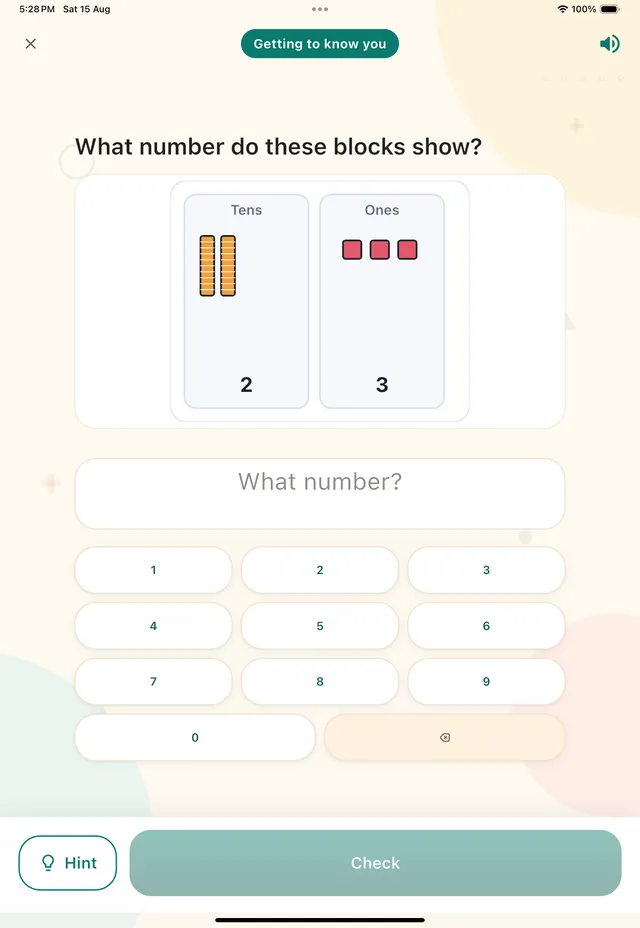
A child who cannot read yet can still do maths. Prompts are spoken aloud, the answers are large enough for a small hand, and the quantities are things to look at rather than symbols to decode.

    A Kenziq question for a young child: how many blocks are shown in the tens and ones columns.
    A real screen from Kenziq: tens and ones as blocks, with a hint button and no timer.

    The curriculum

    Fourteen worlds, and the paths between them.

    Maths is not a pile of worksheets. Each idea rests on the ones before it. Choose a world to see what it asks and what it needs first.

    In your child's hands

    This is the app, not a mock-up.

    Five screens from the Kenziq app as it is today.

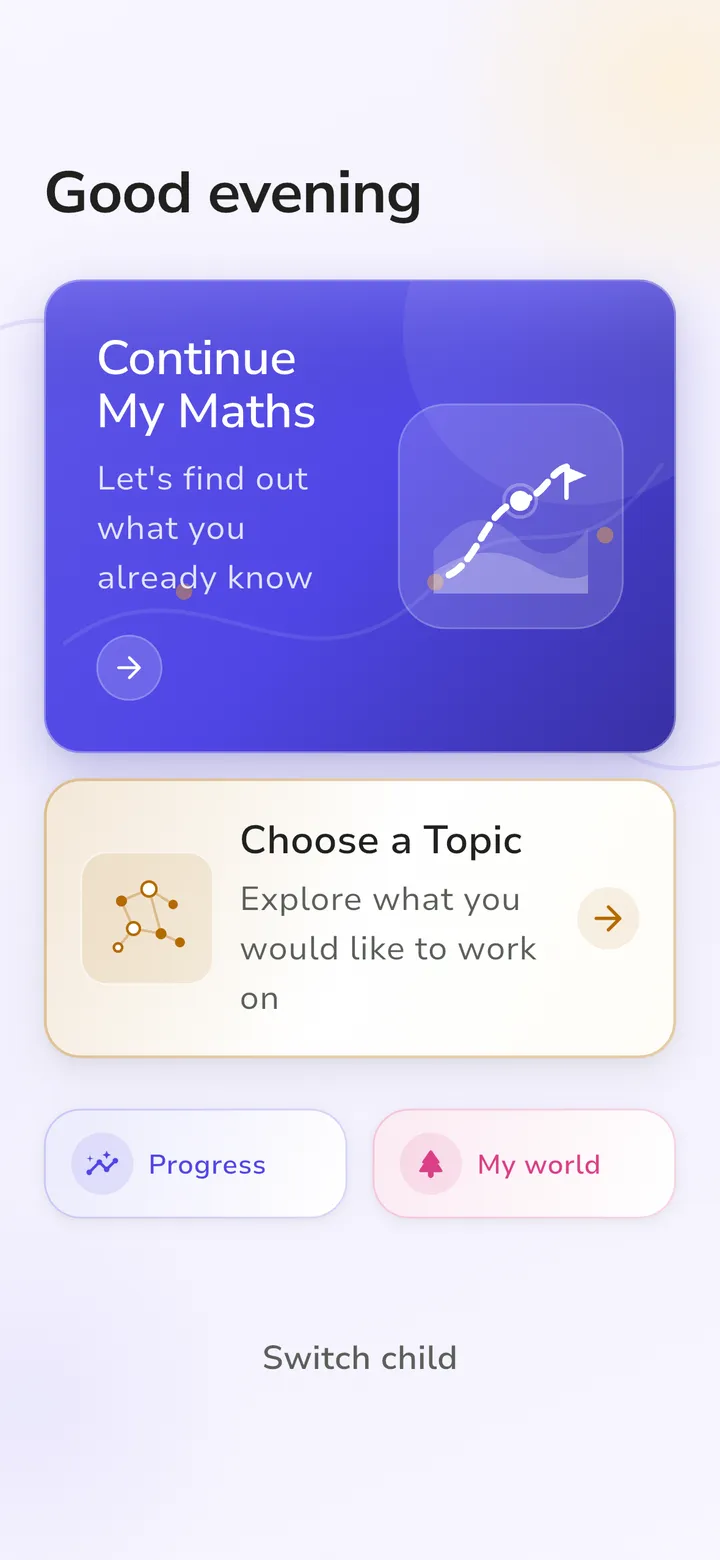
    The Kenziq home screen: Continue my maths, or choose a topic.

    Carry on, or choose a topic. That is the whole home screen.

    Over days, not minutes

    What happens after your child logs off.

    The demonstration above is one question. This is the week around it.

    1. Today

      Your child answers in their own time. There is no clock on the screen.

    2. In the moment

      If an answer is wrong, Kenziq looks at which idea would produce it.

    3. Straight after

      The idea is rebuilt with a picture, in steps, before moving on.

    4. A few questions later

      A different question on the same idea, to see whether it held.

    5. Days later

      It comes back once more, spaced out, so it is remembered rather than crammed.

    For parents

    Know what your child is learning, and what still needs work.

    Enough to help. Not so much that it becomes surveillance.

    Missing a week costs nothing

    No streak to lose, no badge taken away. If your family travels or life gets busy, your child comes back to exactly where they were.

    Nothing designed to hook a child

    No loot boxes, no gem currency to buy, no endless feed, no notification written to pull a child back to the screen.

    Practice is never called proof

    Everyday practice and a proper check are kept separate, and we do not hand out a “100% mastered” badge for a good afternoon.

    Kenziq is in private pilot, so the parent view is still being built with the families using it. If you join, you will be asked what you actually want to see.

    Join the pilot

    Privacy

    What we ask for, and what we refuse to.

    • We never ask a child for their name

      A child's learning is stored against a random identifier. Their name, their school and their email are not in it.

    • A parent sets the account up

      An adult verifies a mobile number and says they are the child's parent or guardian before any learning begins.

    • No advertising, no tracking

      There are no advertising kits in the app and no tracking pixels on this website. Nobody is profiling your child.

    • You can ask us to delete it

      A parent can delete a child's profile from the account, and records that go unused are cleared on a schedule.

    The full detail is in the privacy notice: what is collected, why, how long it is kept and how to have it removed.

    Private pilot · India

    Ready to see maths differently?

    We are opening small cohorts to families and to teachers. Leave a mobile number and we will write when the next one opens.

    Two questions, about twenty seconds. We do not ask for your child's name and there is nothing to pay.

    Join the Kenziq pilot

    Tell us how to reach you and which classes your child is in. We will write to you when a cohort opens.

    A 10-digit Indian mobile number. We use it only to write to you about the pilot.

    Are you writing as

    We ask for a mobile number and a class range. We do not ask for your child's name, school or date of birth, and this form creates no learner account.